Maroon Fence Border: A Designer’s Real-World Review
First Impressions: Fresh, Classical—But Not Fussy
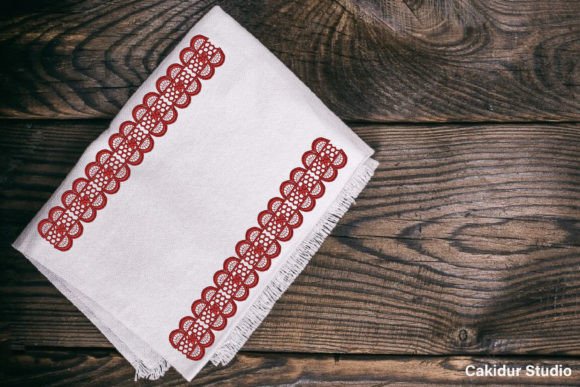
When I opened the Maroon Fence Border embroidery file, what struck me wasn’t just the maroon tone—it was the balance. The abstract floral shapes don’t mimic realism; they suggest growth, rhythm, and quiet confidence. There’s no overworked detail, no fussy petals or tangled vines—just clean, confident curves and intentional negative space. It feels like a border that breathes. That’s rare. Most borders either shout or disappear. This one holds a room—whether it’s framing a monogram on a linen tea towel or wrapping the hem of a baby blanket.
A Real Project Test: Embroidering a Linen Tote for a Local Boutique
Last week, I used Maroon Fence Border to finish a set of custom linen tote bags for a small ceramics shop. They wanted something elegant but grounded—no florals that screamed “vintage wedding,” no geometry that felt cold. We stitched the border along the top 3 inches of each bag, centered and scaled to 4.2". On medium-weight natural linen with tear-away stabilizer and 40-weight maroon and cream thread, the result was instantly cohesive. Customers commented on how “thoughtful” and “handmade-but-polished” the edge looked—not mass-produced, not amateurish. That’s the sweet spot Maroon Fence Border hits when used intentionally.
Where It Shines (and Where It Asks for Attention)
Maroon Fence Border works beautifully on:
- Custom apparel: Sweatshirt cuffs, sleeve hems, and pocket edges—especially on midweight cotton or French terry where stitch definition stays crisp.
- Baby embroidery: Swaddles, bibs, and onesie hems. Its abstract nature avoids cliché while keeping warmth and softness.
- Pillow covers & tea towels: The rhythm of the repeat gives structure without rigidity—ideal for home goods that need quiet personality.
- Embroidered patches: Clean outlines and moderate stitch density mean it presses well and holds shape after sewing onto denim or canvas.
- Holiday and wedding gifts: Paired with subtle monograms or names, it adds heirloom weight without looking dated.
But—and this matters—it needs thoughtful placement on:
- Stretchy fabric: Knits require cutaway stabilizer and possibly reduced density. Test first: some abstract curves can blur if tension isn’t dialed in.
- Thin or sheer fabrics: Like voile or lightweight rayon—backing shows through easily. Add a light iron-on mesh or adjust fill stitch settings.
- Curved surfaces: Caps or curved pillow corners compress design flow. Scale down slightly and avoid placing near seams or crowns.
- Dark or textured backgrounds: Maroon thread on charcoal denim reads rich—but on black velvet or bouclé, contrast fades. Try off-white or ecru thread for lift.
What It Does for Your Craft Business—Beyond Stitching
As an Etsy seller and small shop product developer, I judge borders not just by stitch count, but by how they affect perceived value. Maroon Fence Border elevates a simple tote into a boutique-ready piece because it signals intention. Customers don’t see “border”—they feel “designed.” That builds trust. When you’re selling personalized gifts or handmade products, that quiet professionalism translates directly to repeat buyers and word-of-mouth referrals.
It also plays well across branding: whether your shop leans rustic, modern-minimal, or botanical-luxe, this design adapts without needing heavy editing. I’ve used it as a consistent frame across digital embroidery files, printable mockups, and physical product photography—and it strengthens visual continuity without locking me into one aesthetic.
Practical Designer Notes Before You Stitch
Before adding Maroon Fence Border to your next embroidery project—or listing it as part of a digital embroidery bundle—here’s what I always do:
- Test on scrap fabric—same weight, same weave, same stabilizer you’ll use for the final piece.
- Check thread color contrast in natural light. Maroon reads differently on oat, navy, and cream. Don’t assume.
- Review stitch density. If your machine struggles with dense fills, simplify small inner shapes or reduce satin stitch width slightly.
- Confirm hoop size compatibility. Borders often get resized—make sure your intended scale fits comfortably inside your standard hoop with ½" margin.
- Inspect small details at 200% zoom—especially where stems meet flowers. Abstract doesn’t mean vague; clarity still matters.
- Test in black-and-white mockups. If it holds interest without color, you’ve got strong composition.
- Compare light vs. dark fabric backgrounds in your design software before sending to machine.
- Use proper stabilizer: medium cutaway for knits, tear-away for stable wovens, fusible for lightweight linens.
- Verify licensing before selling finished items or bundling the Maroon Fence Border as part of a commercial embroidery collection.
Final Thought: A Border That Earns Its Place
Maroon Fence Border isn’t flashy—but then, the best design tools rarely are. It’s the kind of embroidery file you reach for when you want your work to feel considered, not cluttered; timeless, not trendy. Whether you’re stitching a single personalized gift or building a cohesive line of craft business products, this border earns its place by doing exactly what a border should: framing the story—not telling it for you.