Christmas Falala: A Designer’s Real-World Embroidery Review
First Impressions: Joyful, Festive—and Immediately Usable
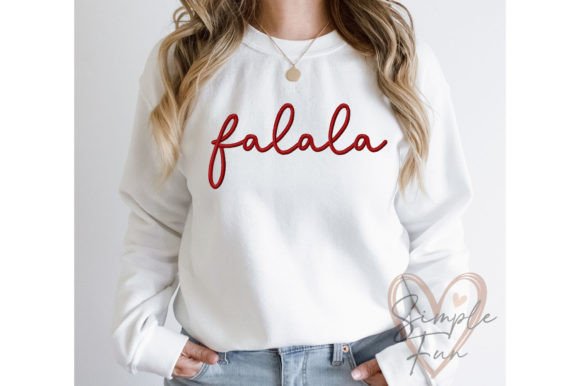
Opening Christmas Falala for the first time, I didn’t see “just another holiday design.” I saw rhythm—light, lyrical, and unmistakably cheerful. The layout leans into playful symmetry without rigidity: looping script, subtle flourishes, and balanced negative space make it feel handmade, not algorithmic. It’s not overly ornate, but it’s not minimalist either. It lands right where most craft businesses need it: festive enough for December, refined enough to hold up year after year on boutique merchandise.
A Real Project in Mind: That Tote Bag You’ve Been Sketching
Last week, I prepped a batch of heavyweight canvas tote bags for a local holiday pop-up—intended as reusable gift carriers with custom embroidery. I tested Christmas Falala at 4.2" wide on one sample. It stitched cleanly across the fabric’s tight weave, with no puckering or thread breaks. The letterforms held their shape, and the slight bounce in the “Falala” tail gave the piece personality—not just decoration. Customers paused mid-aisle. One asked, “Is that hand-lettered?” That’s the signal: when people assume craftsmanship, your machine embroidery design is doing its job.
Where Christmas Falala Shines (and Where It Asks for Care)
Christmas Falala excels on stable, medium-weight fabrics: cotton twill aprons, terry cloth kitchen towels, fleece-lined sweatshirts, and structured caps. Its moderate stitch density avoids heaviness on baby onesies or lightweight tea towels—but I’d skip it on ultra-thin rayon or highly stretchy jersey unless paired with cutaway stabilizer and reduced tension.
On curved surfaces like baseball caps, the design’s width matters more than height. At under 5", it fits comfortably in most standard cap hoops without distortion. But if you’re planning a full-front cap layout, check your hoop size first—some versions may require repositioning or minor digitizing tweaks.
Dark fabric? Yes—with contrast. I ran it in white thread on navy canvas and charcoal fleece. Crisp. Legible. No fill-stitch bleed. On light fabric, navy or forest green thread gives warmth without looking dated. Avoid pale yellow or pastel pink unless you’re intentionally softening the mood—those colors lose definition in satin stitch areas.
Texture & Thread: What Your Fabric Will Tell You
Fabric texture changes everything. On terry cloth towels, the loops absorb some stitch definition—so I recommend tightening the top tension slightly and using a medium-weight tear-away stabilizer underneath. On brushed cotton sweatshirts, the nap can fuzz fine details; a light topping (like water-soluble film) keeps the surface smooth during stitching.
The design includes clean satin-stitched outlines and open fill areas—not dense appliqué or heavy fill stitch blocks. That means less bulk, faster stitch time, and better drape on apparel. For an embroidered patch, it translates well, especially when backed with heat-seal adhesive—but remember: this is a machine embroidery design, not a pre-made iron-on.
For Your Craft Business: Trust, Value, and Repeat Buyers
As an Etsy seller and small shop owner, I judge designs by how they affect buyer confidence. Christmas Falala reads as intentional—not generic, not clip-art-y. When customers see it on a personalized gift (a monogrammed sweatshirt, a nursery pillow cover), they sense care. That perception elevates perceived value, supports premium pricing, and encourages repeat orders.
It also works quietly for branding. Used consistently across holiday product lines—towels, totes, baby blankets—it becomes part of your visual language. Not loud, not trendy, but warmly recognizable. That kind of consistency builds trust faster than any banner ad.
Design Notes Every Embroiderer Should Check Before Stitching
- Test first—always—on scrap fabric matching your final project’s weight and stretch.
- Review stitch density in your embroidery software. Look for tight clusters in curves or corners; those can cause thread nesting or fabric distortion.
- Confirm hoop size compatibility. If you’re stitching on a child’s cap or petite apron, verify the design fits your smallest hoop without scaling down too far.
- Inspect small details: the dot over the “i”, the curl at the end of “Falala”. These define character—and vanish if scaled below 3.5".
- Try black-and-white mockups. Does it read clearly in grayscale? That tells you whether contrast holds up in photos or printed listings.
- Use proper stabilizer. Medium-weight cutaway for knits, tear-away for stable wovens, and fusible + topping for napped fabrics.
- Check licensing. Since this is a digital embroidery file, confirm whether commercial use is permitted before selling finished items or bundling it into design assets.
Final Thought: Not Just Holiday Decor—It’s a Design Partner
Christmas Falala doesn’t shout. It invites. It fits naturally on a handmade product meant to be held, used, gifted, and kept. Whether you’re stitching a last-minute personalized gift, building inventory for your craft business, or creating digital mockups for an Etsy listing, it behaves like a reliable collaborator—not a flashy distraction. It respects fabric, honors thread, and leaves room for your voice as a designer.
That’s rare. And that’s why, after three rounds of real-world testing—on towels, totes, and toddler sweatshirts—I’m keeping Christmas Falala in my core holiday folder. Not because it’s perfect, but because it’s practical, personable, and ready for work.