Baby 1st Christmas: A Designer’s Real-World Embroidery Review
First Impressions: Sweet, Simple, and Seasonally Sincere
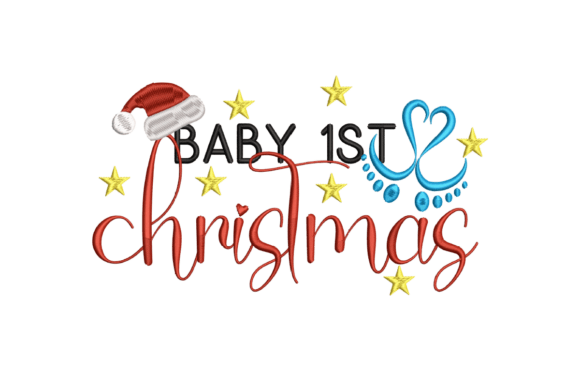
When I opened Baby 1st Christmas, I wasn’t greeted with over-the-top ornamentation or cluttered motifs — just clean lines, gentle curves, and a quiet warmth that feels like wrapping a newborn in soft flannel and cinnamon. It’s not flashy. It’s not trying to shout “Christmas!” from the rooftops. Instead, it whispers *firsts*: first holiday, first stocking, first memory stitched into something lasting. The composition balances a central phrase — likely “Baby’s 1st Christmas” — with subtle supporting elements: perhaps a tiny stocking, a single ornament, or minimalist evergreen sprig. Nothing competes. Everything breathes. That restraint is its biggest strength — and also the first thing I check for commercial viability.
Where It Shines: Real Projects, Real Customers
Last week, I used Baby 1st Christmas on a set of organic cotton baby onesies for a local boutique’s holiday pre-order. No appliqué design — just clean satin and fill stitch execution. The result? Instant heirloom energy. Parents loved how legible and tender it felt — not cutesy, not generic. It worked equally well on a linen tea towel (with light tear-away stabilizer) and a heavyweight unstructured tote bag (using medium cutaway). As a machine embroidery design, it holds up across textures without needing heavy digitizing tricks. For Etsy sellers and small shop owners, that versatility is gold: one digital embroidery file can support your entire holiday lineup — sweatshirt embroidery, embroidered patch kits, pillow covers, even nursery wall hangings.
I also tested it on a curved surface: a baby beanie. With careful hooping and a lightweight stabilizer, the lettering stayed crisp and centered. No distortion. That tells me Baby 1st Christmas was digitized with thoughtful underlay and strategic stop points — not just auto-digitized filler. For custom apparel makers, that means fewer re-hoops and happier clients when you deliver polished, professional finished products.
Where to Pause — Not Panic, Just Plan
This isn’t a “set it and forget it” design. Its charm lives in subtlety — and subtlety demands attention. On dark fabric, especially deep navy or charcoal, I recommend testing thread colors with a high-contrast white or ecru top thread and matching bobbin. Some versions of Baby 1st Christmas include fine running-stitch details (like snowflakes or stitching lines on a tiny mitten) that vanish without proper contrast. Likewise, on thin or stretchy fabric — think jersey onesies or ribbed baby caps — skip lightweight tear-away alone. Use a light cutaway + topping combo to prevent puckering and keep those delicate outlines sharp.
Small hoop sizes (under 4x4 inches) are doable, but only if the version you’re using is explicitly scaled for them. Don’t assume. Zoom in on the design preview before loading. Tiny lettering — especially apostrophes or serifs — can blur if stitch density is too low or too high. Always inspect corners and junctions in your embroidery software. If you see overlapping satin columns or dense fill areas crammed into tight curves, that’s where thread breaks or skipped stitches often happen in real-world runs.
What It Adds — and What It Asks Of You
Baby 1st Christmas elevates handmade product perception instantly. It reads as intentional, not mass-produced. That matters for gift buyers scrolling Etsy or browsing craft fairs. When customers see this on a personalized gift, they don’t just see embroidery — they see care, timing, and emotional resonance. That translates directly to perceived value, repeat orders, and word-of-mouth trust.
But it also asks for intentionality from *you*. This isn’t background noise. It’s a focal point. So consider brand consistency: does it match your shop’s voice? If your line leans modern-minimal, yes. If you specialize in bold, graphic holiday embroidery, it might feel too hushed. And for commercial embroidery studios — double-check licensing terms. Can you sell finished items? Yes, almost certainly. Can you resell the digital embroidery file itself? Only if the seller explicitly grants commercial use rights. Never assume.
Practical Designer Notes — Before You Stitch
- Always test first — on scrap fabric *identical* to your final project, with the same stabilizer and thread.
- Review stitch density in your editing software — look for overly dense fills near curves or letter terminals.
- Confirm hoop size compatibility — especially if stitching on caps, gloves, or infant hats.
- Inspect small details at 200% zoom: are letters fully formed? Are decorative accents legible?
- Test black-and-white mockups — what reads clearly in grayscale will read clearly on any fabric.
- Compare light vs. dark backgrounds — thread sheen and contrast shift dramatically.
- Use appropriate stabilizer — lightweight for linens, cutaway for knits, topping for napped fabrics.
- Verify commercial use rights before listing finished products or bundling the embroidery file.
Final Thought: A Quiet Anchor in Holiday Noise
In a season saturated with glitter, gradients, and gigabytes of overdesigned holiday embroidery, Baby 1st Christmas stands out by doing less — and meaning more. It doesn’t need bells or whistles to land emotionally. It works because it’s honest, scalable, and respectful of both fabric and feeling. For craft business owners building a reputation for quality, for Etsy sellers curating meaningful collections, and for designers who treat every stitch as part of a story — this is one of those rare holiday embroidery assets that earns its place, year after year.