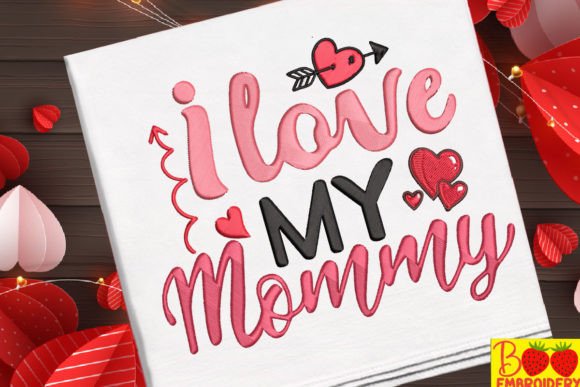
I Love My Mommy
First Impressions: Sweet, Simple, and Surprisingly Versatile
When I opened I Love My Mommy for the first time, I wasn’t expecting much beyond a cheerful phrase—but what stood out immediately was its thoughtful balance. It’s not overly cutesy or cartoonish, nor is it stiffly formal. The lettering has gentle curves, soft edges, and just enough personality to feel handmade without sacrificing legibility. There’s no heavy appliqué, no dense floral frame—just clean lines, well-spaced characters, and a subtle warmth that reads as genuine affection. That matters. In a sea of Mother’s Day embroidery files flooded with hearts, ribbons, and script overload, I Love My Mommy breathes quietly—and that makes it memorable.
A Real-World Test: Embroidering It on a Linen-Cotton Tote Bag
Last week, I stitched I Love My Mommy onto a natural linen-cotton tote for a local boutique’s spring collection. I used medium-weight cutaway stabilizer (non-negotiable for linen’s slippage), 40-weight polyester thread in navy and cream, and kept the hoop size modest—just under 4 inches wide. The result? Crisp satin-stitched letters with zero puckering, even across the fabric’s subtle texture. No skipped stitches, no thread breaks, and the design held its shape through two rounds of gentle machine washing. Customers loved how it looked “designed,” not “downloaded”—a quiet sign of quality craftsmanship that elevates a simple tote into a keepsake.
Where It Shines (and Where It Needs Care)
I Love My Mommy works beautifully on stable, mid-weight fabrics: cotton tees, canvas totes, terry cloth towels, denim aprons, and woven baby blankets. Its moderate stitch density means it won’t overwhelm lightweight knits—or collapse on thick sweatshirts when paired with proper topping stabilizer. As a machine embroidery design, it’s forgiving for beginners but refined enough for seasoned crafters.
That said, proceed with care on:
- Stretchy fabrics like jersey or ribbed baby onesies—always test with tear-away + cutaway combo stabilizer;
- Dark or heavily textured surfaces (e.g., black terry towels)—preview your digital embroidery file in grayscale mockups to confirm letter contrast;
- Caps or curved surfaces—the layout isn’t optimized for front-panel cap hoops; consider resizing or repositioning for better flow;
- Tiny hoop sizes (<4” diameter)—the original scale may crowd corners or limit breathing room around text;
- Frequent-wash items like kitchen towels or baby bibs—verify stitch density holds up after laundering (I recommend checking the fill stitch coverage before finalizing).
For Your Craft Business: More Than Just a Phrase
If you’re an Etsy seller, small shop owner, or custom apparel decorator, I Love My Mommy isn’t just another embroidery file—it’s a reliable asset. It pairs effortlessly with minimalist branding: think neutral-toned sweatshirt embroidery for a boutique’s Mother’s Day capsule, or a single-line embroidered patch sewn onto organic cotton pillow covers. Because it avoids trend-driven embellishment, it stays relevant year after year—not just for Mother S Day, but for baby showers, nursery decor, teacher appreciation gifts, and even wedding “mom & me” keepsakes.
Customers respond to sincerity over sparkle. When a client orders a personalized gift and sees how cleanly I Love My Mommy renders on a linen tea towel—even before stitching—they trust your eye. That trust translates directly into repeat orders and word-of-mouth referrals. For digital product sellers, this design also holds up well in printable mockups: its balanced proportions and clear hierarchy make it easy to visualize across product types without heavy editing.
Designer Notes You’ll Actually Use
Before stitching I Love My Mommy on your next project, here’s what I do—and recommend:
- Always test on scrap fabric first, especially if using new thread colors or stabilizer combos;
- Review thread color contrast—try it in black-on-cream and cream-on-navy to see which pairing best suits your product line;
- Check stitch density visually: zoom into the file viewer and look for tight fill areas that might cause stiffness on baby clothes;
- Confirm hoop size compatibility—some versions may include multiple sizes; choose the one matching your most-used hoop;
- Inspect small details—especially inner curves of “O” and “M”—to ensure they don’t drop stitches on low-tension machines;
- Test light/dark fabric backgrounds using a simple grayscale mockup—it reveals clarity issues no screen preview can;
- Use appropriate stabilizer: cutaway for knits, tear-away for stable wovens, topping for napped fabrics;
- Verify licensing before selling finished items or bundling the digital embroidery file—this affects your craft business compliance and scalability.
Final Thought: A Design That Feels Like a Hug
I Love My Mommy doesn’t shout. It doesn’t need glitter, gradients, or excessive detail to land emotionally. Its strength lies in restraint—clean execution, smart spacing, and quiet confidence in its message. Whether you’re stitching it on a toddler’s onesie, a boutique apron, or a limited-run embroidered patch for a handmade shop, it reads as intentional, warm, and deeply human. In a market where handmade products compete on authenticity, that’s not just practical—it’s powerful. Use it thoughtfully, test it thoroughly, and let the simplicity speak for itself.