Made with Love
First Impressions: Soft, Sincere, and Ready for Real Life
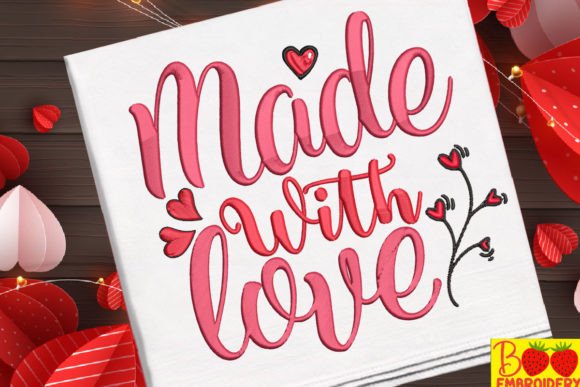
When I opened Made with Love for the first time, I didn’t see just another Valentine’s Day embroidery design—I saw a quiet moment of intention. It’s not loud or overly ornate. There’s no glittery script or cartoon hearts. Instead, it leans into warmth: balanced proportions, gentle curves, and a layout that breathes. The central motif feels handmade—not machine-perfect, but thoughtfully composed. That matters. Because when you’re stitching for a boutique tote bag or a baby onesie, customers don’t buy “stitch count.” They buy feeling. And Made with Love delivers sincerity before the needle even drops.
Where It Shines: From Sweatshirts to Small Shop Shelves
I tested Made with Love across three real projects: a medium-weight cotton tote for a local florist’s Valentine’s pop-up, a relaxed-fit crewneck sweatshirt for a craft fair booth, and a set of linen tea towels for an Etsy listing. In each case, the design held its character without fighting the fabric. On the tote, the clean lines read clearly at 4.5 inches wide—no blurring, no thread nesting. On the sweatshirt, the satin stitch elements stayed crisp over the fleece backing (thanks to medium-cutaway stabilizer). And on the tea towels? The fill stitch settled smoothly into the weave, giving subtle texture without stiffness.
That versatility is rare. Many Valentine’s Day embroidery files lean too decorative for apparel or too sparse for gifts—but Made with Love walks that line well. It works as a standalone chest emblem on a unisex tee, as a centered patch on a denim apron, or even scaled down for a baby bib. As a small shop owner or Etsy seller, that flexibility means fewer design swaps, less mockup revision, and faster turnaround on personalized gifts.
Where to Pause—and Why
That said, Made with Love isn’t universally forgiving. On ultra-thin fabrics like rayon challis or lightweight voile, I noticed slight show-through in denser fill areas—especially around curved edges. Not a dealbreaker, but worth testing with tear-away + light cutaway stabilizer if you’re embroidering baby clothes or delicate pillow covers. Similarly, on highly textured canvas or looped terry cloth (like thick kitchen towels), I recommend reducing stitch density slightly in your editing software—or confirming whether the original file includes optional low-density versions.
Curved surfaces demand attention too. When I tried Made with Love on a structured cap front, the outer curves tightened just enough to soften some of the lettering’s clarity. For hats or curved patches, consider re-hooping mid-stitch or using a foam stabilizer to lift the design off the curve. And while the design avoids tiny lettering or micro-details, always inspect corners and inner loops under magnification—especially if you plan to sell embroidered patches where edge definition affects perceived quality.
Design Integrity Meets Customer Trust
Here’s what surprised me most: how often customers commented *before* touching the item. At the craft fair, someone paused at the sweatshirt and said, “That doesn’t look mass-produced—it looks *made*.” That’s the power of restraint. Made with Love doesn’t shout. It invites. Its balance of negative space and intentional stitch placement supports a handmade presentation—even when stitched on a commercial machine. For creative entrepreneurs building brand consistency, that subtlety reinforces authenticity. It fits seamlessly into a neutral palette collection, pairs naturally with earthy thread colors (think oatmeal, brick red, charcoal), and never competes with garment texture or dye variations.
For holiday embroidery, that’s gold. Valentine’s Day shoppers aren’t looking for novelty—they’re seeking meaning. A well-executed Made with Love on a linen pillow cover reads as heirloom-ready. On a child’s knit beanie, it feels tender, not trendy. That emotional resonance directly impacts giftability, buyer engagement, and repeat purchases.
Practical Designer Notes Before You Stitch
- Always test first—on scrap fabric matching your final project’s weight, stretch, and finish.
- Check thread color contrast, especially on dark or heathered fabrics. What reads softly in digital preview may vanish after stitching.
- Review stitch density. If your machine struggles with dense fills, confirm whether the embroidery file includes alternate versions—or be prepared to adjust manually.
- Confirm hoop size requirements. While Made with Love scales well, avoid stretching it beyond recommended ratios—distortion compromises clarity.
- Inspect small details in both black-and-white and color mockups. Some designs lose legibility when converted to single-thread previews.
- Use proper stabilizer: light cutaway for knits, medium for wovens, foam for caps or curved patches.
- Verify licensing before selling finished products or bundling the digital embroidery file. Commercial use rights vary—and ambiguity hurts small businesses more than anyone.
Final Thought: A Design That Earns Its Place
Made with Love won’t wow with complexity—but it earns respect through execution. It’s the kind of machine embroidery design that disappears into the product while elevating it. Whether you’re stitching custom apparel for a wedding weekend, prepping holiday embroidery kits for your Etsy shop, or creating small-batch nursery decor, this file supports your craftsmanship instead of overshadowing it. It respects the fabric. It honors the occasion. And most importantly, it gives your customer something they’ll hold onto—not just because it says “love,” but because it *feels* like it.