Skeletons Dancing Christmas Santa
A Designer’s First Impression: Playful, Punchy, and Unapologetically Festive
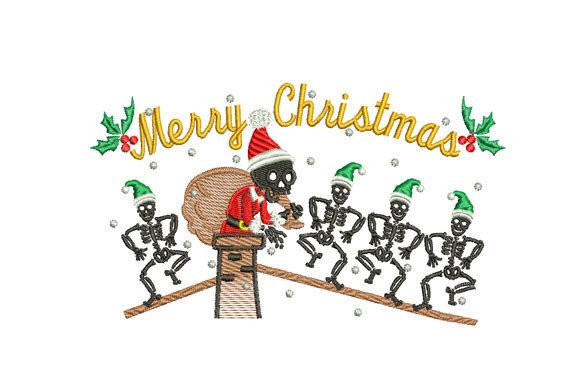
When Skeletons Dancing Christmas Santa first loaded in my embroidery software, I paused—not because it was confusing, but because it landed with such clear personality. It’s not a delicate snowflake or a reverent nativity scene. This is cheeky, rhythmic, and full of motion: skeletons mid-dance, one holding a jingle bell, another tipping a Santa hat, all arranged in a loose circular formation that implies celebration rather than symmetry. The machine embroidery design leans into bold silhouettes and expressive posture—no tiny faces to lose in stitching, no fragile limbs prone to thread breakage. That tells me right away: this isn’t meant for heirloom linens or formal holiday table runners. It’s built for custom apparel, embroidered patches, tote bag designs, and sweatshirt embroidery where wit and wearability matter more than perfection.
Where It Shines—and Where It Needs Thoughtful Placement
I tested Skeletons Dancing Christmas Santa on a heavyweight cotton twill tote bag first—my go-to for small shop product prototyping. With medium-weight cutaway stabilizer and 40-weight polyester thread, the satin stitch edges held crisp, the fill stitch areas stayed smooth, and the running stitch accents (like the bell clapper and hat trim) read clearly without bleeding. Customers at our local craft fair responded immediately—smiling, snapping photos, asking if we’d do matching sweatshirts. That’s the power of a strong, legible holiday embroidery design: it sparks conversation before anyone even reads the tag.
It also worked beautifully as an embroidered patch on denim jackets—stitched out cleanly, then heat-applied with a light iron press. For baby embroidery? I’d recommend it only on structured items like bibs or blanket corners—not onesies. The scale and energy feel better suited to toddler hoodies or family matching sweatshirts than newborn onesies, where subtlety often reads as more thoughtful.
But here’s where attention matters: Skeletons Dancing Christmas Santa has moderate stitch density—not sparse, not overwhelming—but that means it won’t behave predictably on stretchy fabric like jersey knits without careful stabilization. On thin fabrics (think lightweight tea towels or linen napkins), I’d reduce stitch count slightly or add tear-away backing underneath the cutaway to prevent shadowing. And on dark fabric? Test your thread colors thoroughly. A creamy off-white works better than stark white for warmth; charcoal gray thread on black fleece gives depth without dullness.
Real-World Fit for Creative Businesses
As an Etsy seller and small shop owner myself, I’ve seen how a single well-chosen digital embroidery file can become a seasonal anchor—reused across mugs (as iron-on transfers), pillow covers, aprons, and even holiday cards (via printable mockups). Skeletons Dancing Christmas Santa fits that role perfectly. Its theme is unmistakably Christmas, yet its irreverent tone appeals to Gen X and millennial buyers who want handmade products with personality—not mass-produced sentimentality.
For craft business owners, this design scales well across price points: stitched simply on a $25 canvas tote, it feels premium; applied as a small chest logo on a $65 organic cotton sweatshirt, it adds brand charm without dominating. I wouldn’t use it on curved surfaces like caps without re-hooping mid-stitch—it’s best centered on flat or gently contoured areas. And while it’s not an applique design, its clean outlines make it easy to adapt later with fabric overlays if your workflow includes hybrid techniques.
What Your Customers Actually Notice
- Visual appeal: Bold enough to catch eyes at 6 feet—but not so busy it competes with garment texture.
- Stitching clarity: No micro-details to vanish in fill stitch; every skeleton reads as distinct, even at 4” wide.
- Product value: Adds perceived craftsmanship to simple items—turning a plain sweatshirt into a personalized gift.
- Brand consistency: Works across playful, modern, or vintage-leaning shops—as long as humor and quality are part of your voice.
- Giftability: People buy it *for others*—not just themselves. That’s rare and valuable during holiday seasons.
Practical Designer Notes Before You Stitch
Before adding Skeletons Dancing Christmas Santa to your next client order or Etsy listing, do these five things:
- Run a test on scrap fabric matching your final project’s weight and weave—especially if using textured fabric like terry cloth or bouclé.
- Check thread color contrast on both light and dark backgrounds. Some shades look vibrant on white but muddy on navy.
- Confirm hoop size compatibility. If you’re limited to 4x4 hoops, verify whether the design fits—or if it requires repositioning.
- Inspect small details in your embroidery software: are any interior lines too narrow for reliable satin stitch? Adjust if needed.
- Review licensing. Since this is a commercial embroidery project, confirm whether the digital embroidery file permits resale of finished products—and whether attribution is required.
This isn’t just another holiday embroidery design. Skeletons Dancing Christmas Santa carries rhythm, intention, and market awareness in its layout. It respects the limits of home embroidery machines while delivering something that feels professionally crafted. Whether you’re making personalized gifts, stocking small shop shelves, or building a portfolio of design assets, it earns its place—not because it’s trendy, but because it stitches true, sells well, and makes people grin.