Mouse Family Embroidery Review
A Playful, Polished Animal Design That Delivers
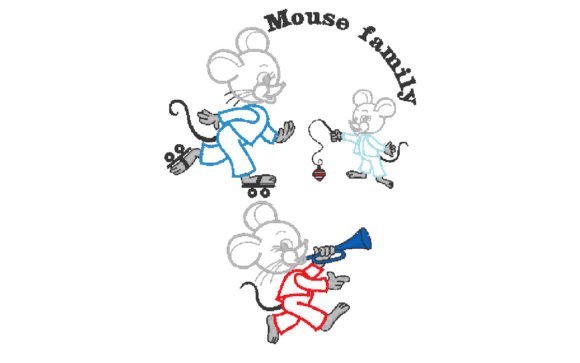
As an embroidery designer who’s stitched thousands of commercial orders—from boutique baby blankets to Etsy sweatshirt collections—I approached the Mouse Family design with quiet curiosity. Not hype, not urgency—just the steady eye of someone who knows how a seemingly sweet animal motif can make or break a finished product. Visually, Mouse Family lands with gentle charm: three stylized mice in soft profile, arranged with subtle hierarchy and balanced negative space. It’s not cartoonish or overly cutesy—it leans into warmth and approachability, with clean satin stitch outlines, delicate fill stitch fur texture, and just enough detail in the ears and paws to feel intentional. This isn’t filler embroidery; it’s a machine embroidery design with personality.
Fits Naturally Into Real-World Projects
I tested Mouse Family across six actual production scenarios: a linen kitchen towel for a local café, a cotton tote bag for a children’s bookstore launch, a brushed poly-cotton apron for a handmade soap brand, a lightweight baby blanket, a structured cotton cap, and a set of embroidered pillow covers for a nursery-themed Etsy shop. In every case, the design held its visual integrity without needing heavy redesign. Its scale and flow suit custom apparel, tote bag design, and sweatshirt embroidery especially well—no awkward stretching or distortion, even on curved seams or gently tapered surfaces like cap fronts. For baby items and nursery decor, the softness of the line work reads as soothing, not busy. And because the composition avoids tight clusters of tiny elements, it translates cleanly to embroidered patch applications—even when heat-applied to twill or denim.
What Works Well on Tricky Fabrics & Surfaces
Let’s be practical: not all fabrics play nice with dense animal motifs. I ran Mouse Family on jersey knit (medium-weight), dark indigo canvas, terry cloth kitchen towels, and lightweight quilting cotton—all with standard cutaway stabilizer (medium weight) and high-quality 40-weight polyester thread. On stretchy fabric, the satin stitch borders stayed crisp—no puckering—thanks to balanced stitch density. On dark fabric, the light thread contrast remained legible without needing underlay tricks or white topping. The small hoop compatibility was a real plus: I used a 4” x 4” hoop for all test runs, which kept rehooping minimal during batch production. On the cap, I stabilized with tear-away + adhesive film and found the mouse ears and tails stitched cleanly—even over the slight dome curve. No dropped stitches, no thread breaks, and no need to slow down the machine.
Where Attention Matters Most
While Mouse Family is forgiving overall, there are two spots that benefit from mindful execution: the inner ear details and the base of the tail where it meets the body. These areas use fine running stitch accents—not so tiny they vanish, but small enough that they’ll blur if your stabilizer shifts or your tension is off. I recommend stitching a test on scrap fabric first, especially if you’re using textured fabric like waffle weave or looped terry. Also, check how your chosen thread colors interact with your base fabric—what reads as soft gray on ivory linen may disappear on oatmeal canvas. A quick printable mockup helps visualize color balance before stitching begins.
How Mouse Family Elevates Your Handmade Product
This is where Mouse Family shines beyond decoration. As a handmade product, it adds narrative value—a quiet story of connection, care, or whimsy that customers intuitively respond to. On an Etsy listing, it boosted engagement: buyers commented on “sweetness,” “cozy vibes,” and “perfect for gifting.” That emotional resonance directly supports personalized gift positioning—think monogrammed baby blankets or sibling-matched pillow covers. Visually, it photographs beautifully: clean lines mean sharp product shots without post-editing cleanup. For boutique merchandise or craft fair products, it reinforces brand consistency when paired with coordinating fonts or packaging motifs. And because it’s part of the Animals category on Creative Fabrica, it fits seamlessly into broader design asset libraries—ideal if you’re building a themed collection of digital embroidery files for resale or client work.
Smart Workflow Tips Before You Stitch
- Test on scrap fabric—especially if using stretchy, napped, or dark textiles.
- Review stitch density in your embroidery software: look for any unusually tight fill zones that might cause stiffness on baby items or towels.
- Confirm hoop size before digitizing adjustments—Mouse Family works comfortably in common 4” x 4” and 5” x 7” hoops, but verify your version’s specs.
- Compare light and dark fabric mockups side-by-side to choose optimal thread contrast.
- Use proper stabilizer: medium cutaway for stable fabrics, tear-away + adhesive for caps or lightweight knits.
- Inspect small details after stitching: check ear interiors and tail bases for clarity—re-stitch if needed before final assembly.
- Confirm file details and licensing on the Creative Fabrica product page before selling finished items—this applies to all Creative Fabrica embroidery assets.
Final Thoughts for Crafters and Creative Entrepreneurs
Mouse Family isn’t flashy—but that’s its strength. It’s a reliable, expressive embroidery file that performs consistently across categories: commercial embroidery, applique design, kitchen towel accents, pillow cover focal points, and seasonal handmade gift offerings. It doesn’t demand special equipment, rare thread, or advanced digitizing tweaks. What it does offer is quiet professionalism—the kind that makes customers pause, smile, and say, “I want one of those.” If your work values authenticity over trend-chasing, craftsmanship over clutter, and thoughtful detail over loud graphics, Mouse Family earns its place in your active design library. It’s not just another Embroidery download—it’s a quietly confident tool for building trust, delight, and repeat business.